Eycore and NanoAvionics Launch Polish SAR Satellite Alongside Neutrino Science and Quantum Missions on SpaceX CAS500-2
Press releases
2026-05-05
Vandenberg Space Force Base, California, USA, and Vilnius, Lithuania, 3 May 2026 – SpaceX’s second CAS500 (Compact Advanced Satellite 500) mission to low-Earth orbit (LEO) carried, among others, three satellites using buses from small-satellite manufacturer Kongsberg NanoAvionics (NanoAvionics) into orbit:
Eycore-1, a pilot for an all-European, military-grade Synthetic Aperture Radar (SAR) solution and NanoAvionics’ platform debut for SAR applications,
QUBE II, demoing the first-ever quantum key exchange between a CubeSat and a ground station,
and SNAPPY (Solar Neutrino Astro-Particle PhYsics), the world’s first space-based neutrino detector.
Following a successful launch, NanoAvionics’ mission control established contact with all satellites under its operations on the first attempt. This continued the company’s 100% first-contact success rate and brought the total number of NanoAvionics-built satellites launched to more than 60.
Atle Wollø, CEO of Kongsberg NanoAvionics, said: “CAS500-2 was a very exciting launch as it carried three highly innovative and important satellite missions for cutting-edge science, unhackable communications, and strategic reconnaissance. These missions further demonstrate NanoAvionics’ capability to adapt to diverse customer missions across science, communications, and defence applications.
“The Eycore-1 mission marks our platform debut for SAR applications and reflects how we help partners like Eycore to deliver critical capabilities. By integrating Eycore’s SAR technology with NanoAvionics’ flight-proven platforms, our companies are expanding Europe’s access to sovereign intelligence and surveillance. This mission adds SAR to our supported application portfolio, alongside optical and thermal imaging, RF maritime surveillance, and signals intelligence. It highlights our ability to support national security with cost-effective, mission-ready satellite platforms.”
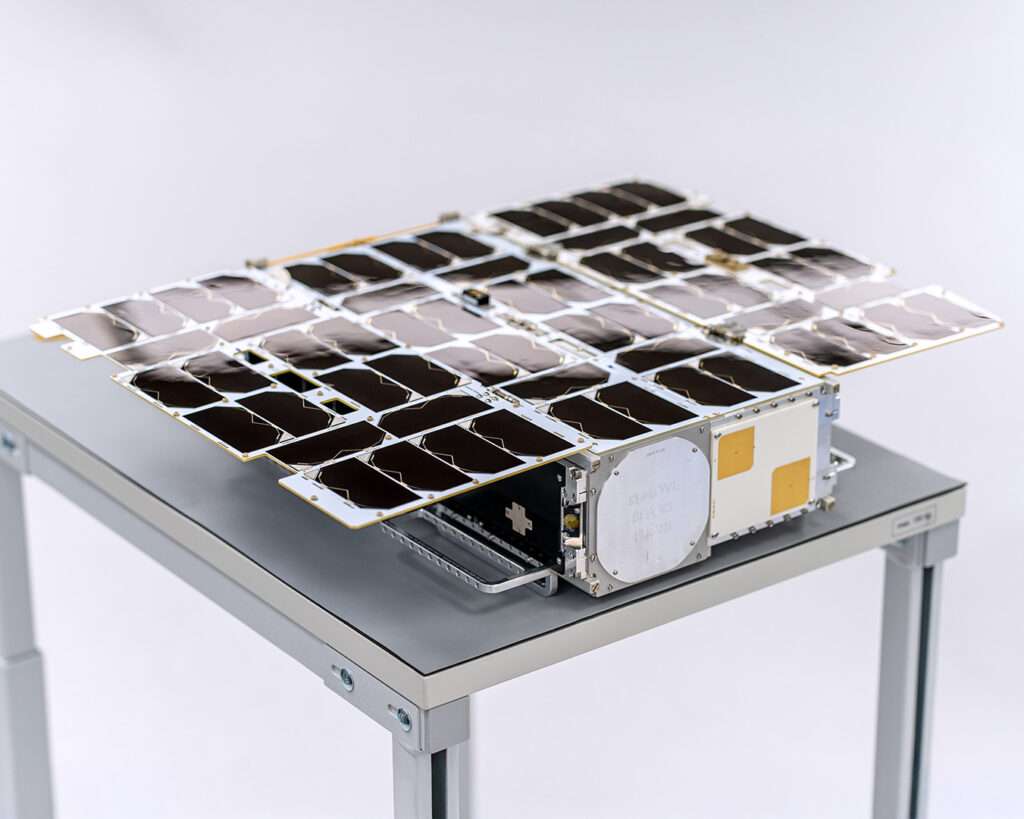
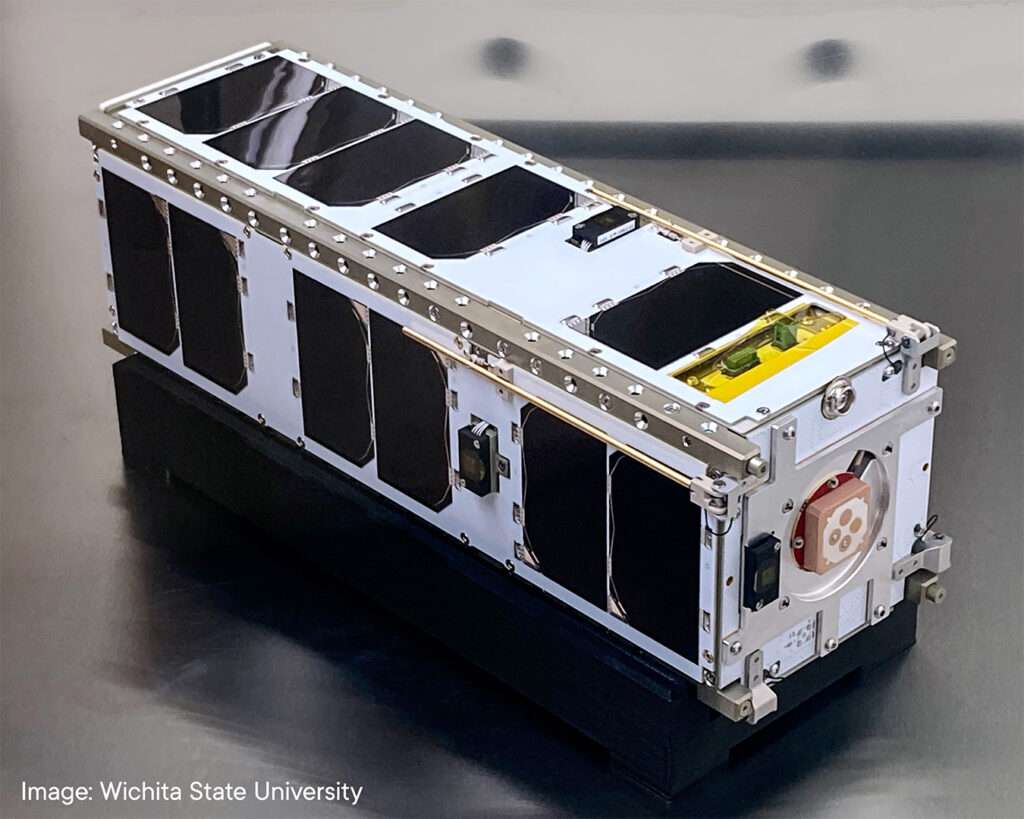
QUBE-II QKD satellite. Credits – Kongsberg NanoAvionicsSNAPPY neutrino detector. Credits – Wichita State University
Satellites aboard CAS500-2 using NanoAvionics satellite buses:
Eycore-1 by Poland’s Eycore, a developer of compact synthetic-aperture-radar (SAR) payloads, will test Eycore’s X-band radar on NanoAvionics’ 200 kg-class, flight-proven MP42 microsatellite bus. The mission will validate an all-European, military-grade SAR solution that provides governments with rapid, sovereign access to sub-meter, day-night, all-weather imagery. It aims to lay the groundwork for further Next-Gen SAR satellites for NATO and Allied defence applications. Through this mission, Eycore became the second fully private European company to place a SAR satellite in orbit.
QUBE II is an 8U CubeSat that will demonstrate the first-ever quantum key exchange between a CubeSat and a ground station. It aims to build the foundation for cost-effective, unhackable global communications using a compact, lightweight optical terminal. The QUBE-II satellite project is a joint research initiative of the German Federal Ministry of Research, Technology and Space (BMFTR) on Quantum Communication. Zentrum für Telematik Würzburg (ZfT) is the satellite system responsible, while OHB System AG coordinates the overall system, including payloads from German Aerospace Center (DLR), Ludwig Maximilian University of Munich, and the Friedrich-Alexander-Universität Erlangen-Nürnberg.
SNAPPY is a NASA Innovative Advanced Concepts (NIAC)-funded 3U CubeSat, developed in collaboration between Jet Propulsion Laboratory (JPL), NASA’s Marshall Space Flight Center, and the universities of Wichita, South Dakota, Minnesota, and Michigan.
The space-based solar neutrino detector was designed and developed at Wichita State University (WSU), which leads the project, with electronics provided by NASA Marshall, and a pre-integrated 3U CubeSat bus provided by Kongsberg NanoAvionics.
SNAPPY will measure background rates relevant to solar neutrino detection via a double-pulsed signature that cleanly identifies true solar neutrino interactions. It aims to help validate the feasibility of a larger detector positioned closer to the Sun, where the neutrino flux from the fusion core is expected to be 1,000 times or higher than at Earth.
Dr. Nickolas Solomey, professor of mathematics, statistics, and physics at WSU, said: “No one has ever operated a neutrino detector in space. This mission will allow us to look at the sun in a very new way and perform experiments impossible here on Earth.”