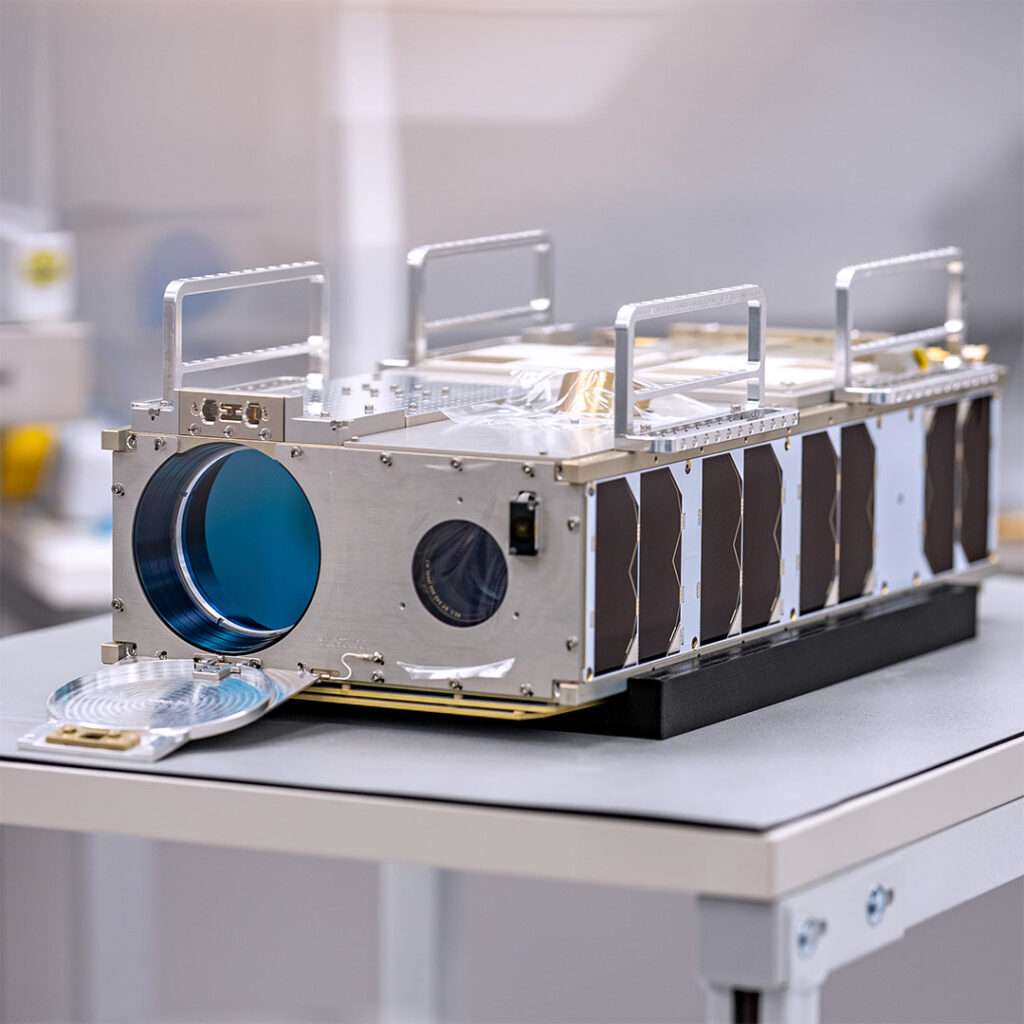
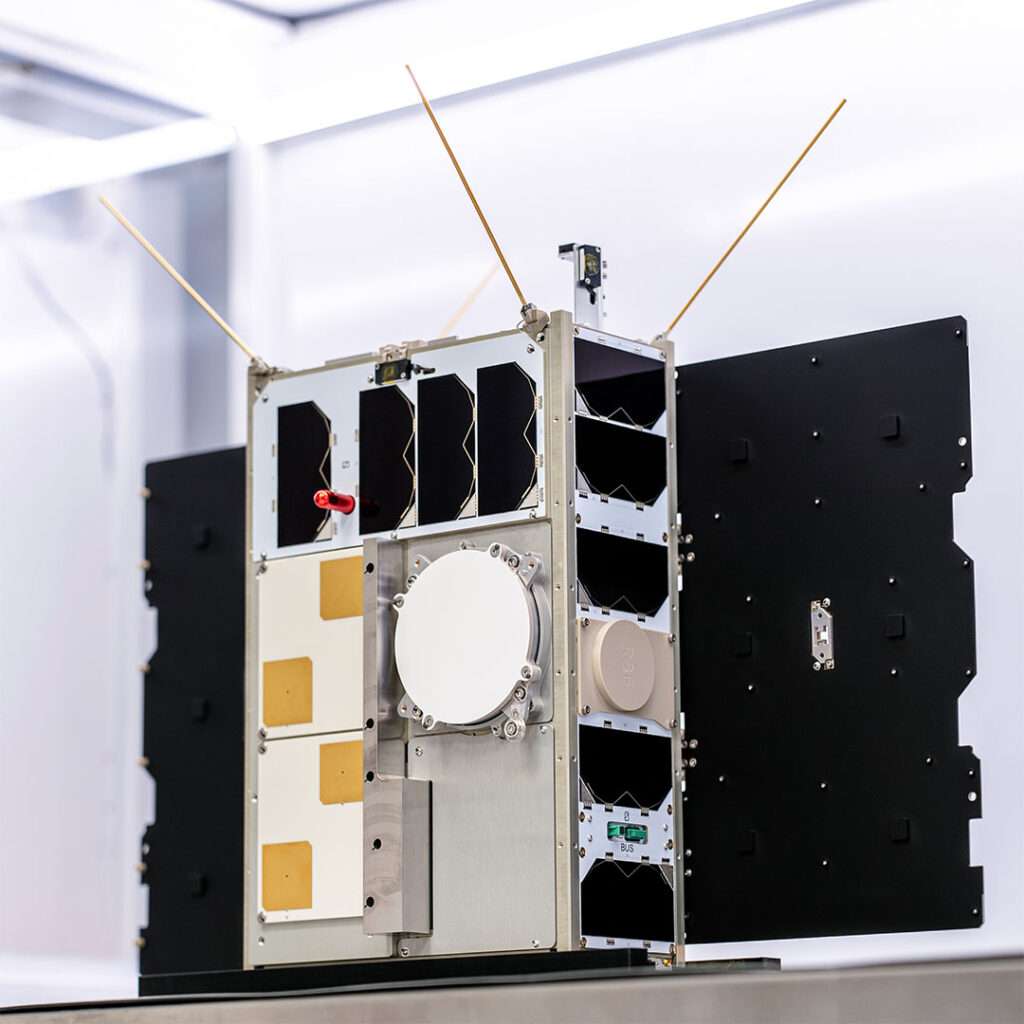
NanoAvionics-built FlyLab satellites successfully launched on SpaceX Transporter-16 for French Aerospace Lab ONERA
Press releases
2026-03-31
SpaceX Transporter-16 launch extends NanoAvionics’ 100% first-contact success record
ONERA FlyLab-1 and FlyLab-2 satellites to demonstrate coordinated in-orbit operations
Modular microsatellite power and communications systems deployed across customer spacecraft
Vilnius, Lithuania, 31 March 2026 – Kongsberg NanoAvionics (NanoAvionics) has successfully established two-way communication with two satellites built for the French Aerospace Lab ONERA following their launch aboard SpaceX’s Transporter-16 rideshare mission on 30 March at 10:19 UTC. The FlyLab-1 and FlyLab-2 CubeSats were deployed into a 590 km sun-synchronous orbit and are now beginning their commissioning phase, marking the start of the FlyLab mission to demonstrate close-proximity formation flying and advanced in-orbit research.
Following a successful launch and initial contact, both satellites are healthy in orbit and entering their commissioning phase. Once operational, the pair will execute coordinated, close-range formation flying maneuvers enabled by high-precision attitude determination and control systems (ADCS).
The FlyLab mission is designed as a multi-disciplinary in-orbit laboratory, combining formation flying with Earth observation and radio frequency (RF) sensing capabilities.
FlyLab-1, based on NanoAvionics‘ 8U CubeSat platform, carries uncooled thermal infrared and visible-spectrum cameras. These payloads will support both formation flying validation and dual-spectrum Earth observation, enabling data collection across complementary spectral bands. The satellite also has an electric propulsion system for fine orbital maneuvers.
FlyLab-2, built on a 6U CubeSat platform, carries a hybrid cold gas propulsion system and focuses on RF sensing and atmospheric research. It is equipped with VHF antennas and a software-defined radio (SDR) to study the ionosphere by receiving signals transmitted from the ground. A second SDR, paired with an L-band antenna, will analyse radar signals from a ground-based transmitter.
Together, the two satellites will demonstrate how coordinated small satellite systems can perform complex missions traditionally reserved for larger spacecraft, including precise orbital manoeuvring.
The successful launch marks NanoAvionics’ second mission of the year and brings the total number of company-built satellites launched to more than 55, maintaining a 100% first-contact success rate across all missions.